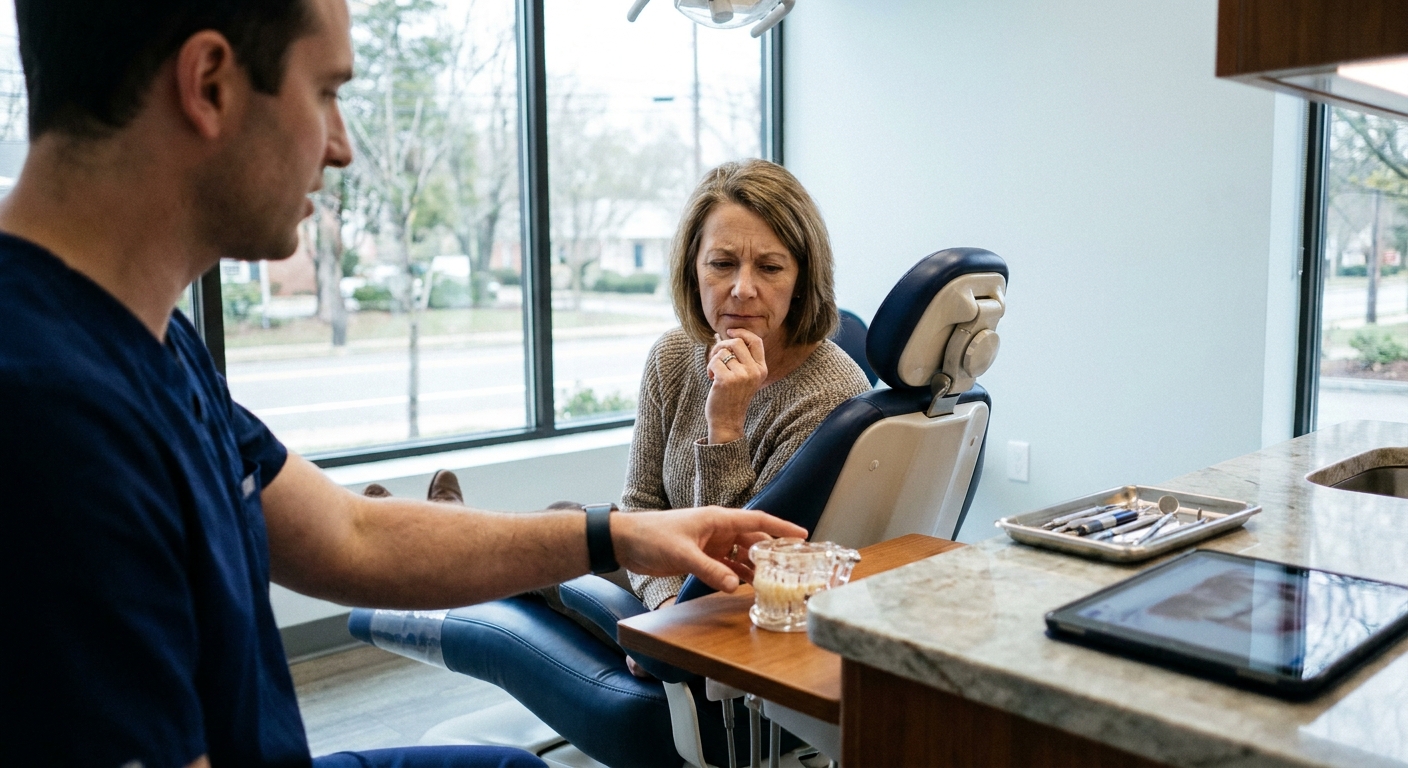
Most people assume a partial denture is the default answer for missing teeth, since it’s the option mentioned first and the one that asks the least of your mouth up front. For many patients at Belmont Dental, though, it turns out to be the wrong fit, which is why they end up looking at a single-tooth implant, a fixed bridge, or a different removable option instead. Which of those may suit you depends on your mouth, your goals, and your budget.
How do partial dentures work, and why might they not fit every person?
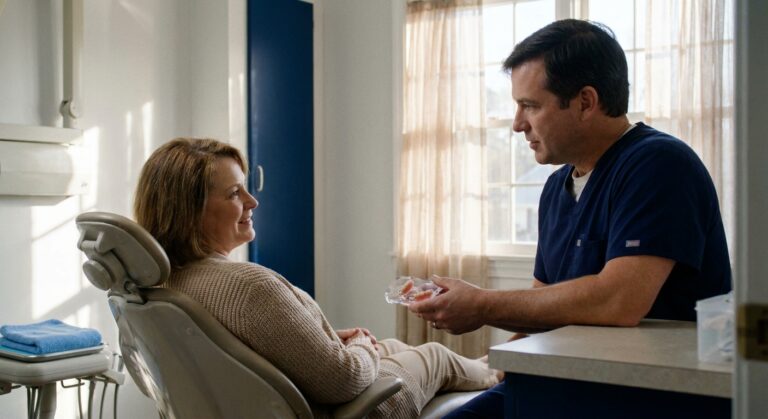
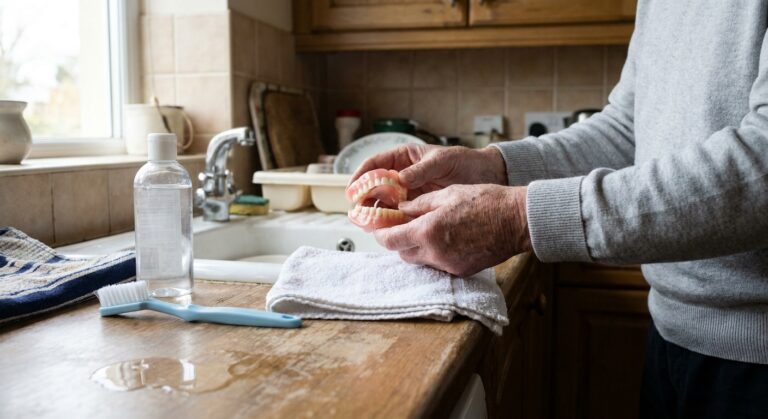
A removable partial denture rests on your gums and usually clips onto nearby natural teeth with small clasps. You take it out to clean it, and most people remove it at night. Some people find that routine easy. Others find the plate bulky against the tongue, notice food slipping underneath, or see a clasp when they smile, and it can start to feel like a compromise they never really chose.
The alternatives place the support somewhere else. An implant anchors a single replacement tooth in the jawbone, so it does not rely on neighboring teeth. A bridge fills the gap by attaching a false tooth to crowns on the teeth on either side, which usually means those neighboring teeth are reshaped to hold it (NCBI Bookshelf).
A Cochrane evidence summary on replacing missing teeth found that the research comparing these approaches is too limited to name one best choice for everyone. That is why your exam, your goals, and your budget guide the decision. At Belmont Dental, the aim is to develop a plan that fits your situation and that you can realistically complete. Here is how the options usually line up:
- Single-tooth implant: may suit an adult missing one tooth who has healthy neighboring teeth, enough bone at the site, and time to heal before the final crown.
- Fixed bridge: may suit a person who wants a fixed tooth without implant surgery, especially when the teeth beside the gap are strong enough to anchor it.
- A different removable option: may suit a person missing several teeth, one who wants the simplest path, or one who needs to keep costs down for now.
These are starting points. Your exam determines which one may fit you.
What can I get instead of a partial denture if I want one tooth replaced on its own?
A single-tooth implant replaces one missing tooth without relying on the teeth beside it, and it is the implant work Belmont Dental plans and places in its own office.
An implant is a small post placed in the jawbone where the root used to be. Once the bone bonds to it, a crown goes on top. Because the implant does not hook onto neighboring teeth, those teeth are not reshaped.
Planning happens before surgery day using digital technology. The team takes a CBCT (cone beam CT) 3D scan and reviews it in Sidexis imaging software, looking at bone volume, nearby roots, and structures such as the nerve in the lower jaw. In one lower-molar case we treated, the CBCT showed the bone and nerve in different positions than a flat X-ray had suggested. The team adjusted the implant length and position on screen before surgery and kept about 3 mm of clearance from the nerve canal.
Many straightforward single-tooth implant procedures can be completed with local anesthesia. If dental anxiety is a concern, the team will talk through other options with you.
What the implant timeline looks like
- A clinical exam of the site, your gums, and nearby teeth.
- A CBCT 3D scan to measure bone and map anatomy.
- An intraoral digital scan of your bite and the space the crown will fill.
- Digital planning in Sidexis, completed ahead of the surgical appointment.
- Implant placement in the office when the site is appropriate.
- Roughly 3 to 4 months of healing while the implant fuses with the bone (osseointegration), though timing varies.
- Your final implant crown.
Timing depends on the site, your bone quality, whether grafting is needed, and how you heal.
When might a fixed bridge be worth considering?
A bridge may be worth considering when the teeth beside your gap are strong anchors and you want a tooth that stays put without implant surgery. It is cemented in place, so you do not take it out at night.
The trade-off comes from the design. You skip the months of implant healing, but the neighboring teeth are reshaped to receive crowns. If those teeth are healthy and untouched, that is a real cost to weigh. If they already have large fillings or need crowns anyway, a bridge may address two needs at once. You clean under it with floss threaders or a water flosser, and your hygienist can show you how at your regular cleanings.
Bridges and crowns are part of Belmont Dental’s general dentistry, so this option stays under one roof with your family’s routine care. Dr. Cook examines the supporting teeth, checks your gums and bite, and tells you plainly whether those teeth may be suitable anchors. If they are not, the conversation moves to other options.
What if you still prefer a removable option?
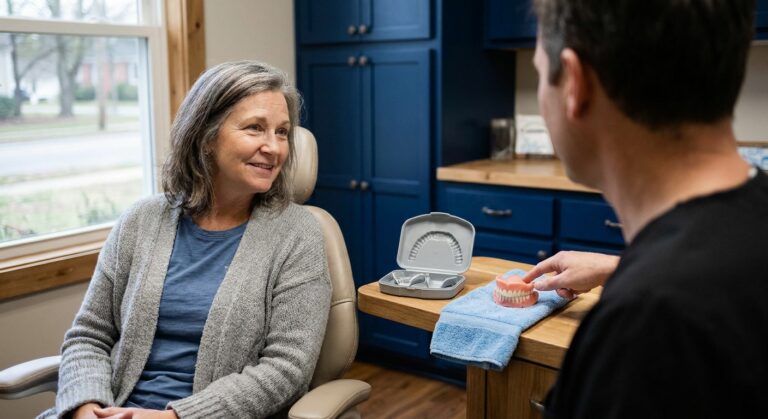
That is a reasonable choice, and for many people it is the right one. When teeth are missing in several places, one removable appliance can replace them together, with no surgery and no crowns on healthy teeth. Because Belmont Dental phases care, you might choose a removable option now and revisit a fixed option later.
Types of dentures and who each one may fit
| Type | What it replaces | Who it may fit |
|---|---|---|
| Full denture | All the teeth in the upper or lower jaw | A person who has lost, or needs to lose, every tooth in an arch |
| Partial denture | Several missing teeth, held by clasps on remaining teeth | A person who still has healthy natural teeth but is missing teeth in one or more spots |
| Immediate denture | Teeth removed on the same day it is placed | A person having teeth taken out who does not want to go without teeth while the gums heal |
Can I eat with dentures?
Many people return to a wide range of foods, but it takes practice. In the first few weeks, start with soft foods cut into small pieces and chew on both sides at once to help keep the denture steady. As your mouth adjusts, you can try firmer foods. Very sticky or very hard foods may remain tricky, and a partial is often more stable than a full denture because it holds onto your natural teeth. If eating stays uncomfortable, an adjustment visit may help, and telling your dentist exactly what bothers you is part of building the right plan.
How do I get dentures in Belmont, NC?
The process typically follows these steps:
- Consultation and exam: the dentist checks your teeth, gums, and bone and talks through your goals and budget.
- Treating urgent needs first: cavities, infection, or gum disease are addressed before the denture is made.
- Impressions and bite records: the dentist records the shape of your mouth and how your jaws meet.
- Try-in: you see and feel a preview so the fit, shade, and look can be adjusted.
- Final fit: your finished denture is placed and checked for comfort.
- Follow-up adjustments: small adjustments in the weeks after help it settle in.
You can read more about custom dentures at Belmont Dental before your visit.
What does Belmont Dental refer to specialists?
Belmont Dental keeps its implant work to straightforward single-tooth cases. If your needs point toward replacing a full arch, or a site needs a larger bone rebuild, a sinus lift, or deeper sedation, the team tells you so and coordinates with a trusted specialist for that step.
A referral does not mean starting over. Your exams, cleanings, fillings, crowns, and bridges continue at Belmont Dental with a tenured team that already knows your family’s history.
How do you plan and pay for the option you choose?
Care is planned in phases: disease, pain, and function first, then elective work as your budget allows. You leave knowing what needs attention now and what may be able to wait.
Belmont Dental accepts Aetna, Assurant, Blue Cross Blue Shield, Cigna, Delta Dental, GEHA, Guardian, and MetLife, and coverage for bridges, implants, and dentures varies by plan. If you do not have insurance, the Belmont Dental Membership Plan offers Adult Care, Perio Plus, and Child Plus tiers, with savings on additional treatment according to the plan. Financing is also available. Fees are discussed once your exam shows what you need.
The answers you probably still need before you book
What can I get instead of a partial denture? Many people choose between a single-tooth implant, a fixed bridge, or a different removable option, depending on how many teeth are missing, the health of nearby teeth and bone, their goals, and their budget.
Can dentures be whitened? No, denture teeth do not respond to whitening gel the way natural enamel does. Surface stains can often be reduced with proper daily cleaning and a professional cleaning, and if you plan to whiten your natural teeth, it is best to do it before a new partial is made so the shades can be matched.
Is an implant better than a partial denture? It depends on the person. An implant stands on its own but requires enough bone, minor surgery, and a few months of healing. A partial avoids surgery and can replace several teeth at once.
Does Belmont Dental place implants for a full arch of teeth? No. Straightforward single-tooth implants are handled in-house, and full-arch cases are coordinated with a specialist.
Where can Belmont, NC patients start the conversation?
Start with an exam at Belmont Dental, where Dr. Cook and a tenured team have cared for Belmont, NC families since 2005. The dentist examines the gap, checks your gums, and asks what matters most to you: comfort when you eat, how your smile looks, cost, or simply being done with a removable appliance. If an implant may be possible, a CBCT scan shows what your bone allows, so the recommendation is based on your own mouth.
Book your exam using the booking option on this page. Before you go, write down the one thing you dislike most about a partial, or the one thing you worry about most with the alternatives. That single sentence can tell your dentist more about which option may fit you than any comparison chart can.
Not Sure Which Option Fits Your Smile?
Reading about alternatives to a partial denture can leave you wondering which one actually makes sense for your mouth, and it is fine not to know yet. The team at Belmont Dental in Belmont, NC can look at your teeth and gums, talk through what you want, and help you understand which options are realistic for you. Call the office when you are ready to start that conversation.
Every mouth is different, and individual experiences and results vary.