When you have tooth pain or signs of infection, it can be tempting to wait and see if things get better on their own. With a dental infection, waiting is exactly what you should not do. Seeing a same day dentist for infection is one of the most important steps you can take to protect your health, your comfort, and your teeth.
Infections in your teeth or gums almost never resolve without professional help. They tend to spread, become more painful, and can eventually turn into serious medical emergencies if you delay care. By understanding what is happening in your mouth and why timing is so critical, you can make safer decisions about when to seek treatment.
Why tooth and gum infections are so serious
A dental infection is not just a “bad toothache.” It is an active infection that can spread through soft tissue, jawbone, and sometimes into the bloodstream.
How a dental infection develops
Most tooth infections start with:
- Deep tooth decay that reaches the pulp
- A cracked or broken tooth that exposes the inner layers
- Severe gum disease that creates pockets for bacteria
- A failed or leaking filling or crown that lets bacteria in
Once bacteria reach the pulp or deep gum tissue, they multiply and create pus. This buildup of infection can form a tooth abscess at the tip of the root or along the gumline. Abscesses are considered dental emergencies and require prompt treatment to prevent the infection from spreading to other parts of your body [1].
Why infections will not heal on their own
Once you have a true tooth or gum infection, your body alone usually cannot clear it. The infected tissue is trapped inside the tooth or deep in the gums, where your immune system and home remedies cannot fully reach.
Professional treatment is needed to:
- Drain the abscess
- Remove infected tissue inside the tooth or gums
- Clean and seal the area so bacteria cannot re-enter
Without these steps, the infection often progresses and can spread to the jaw, neck, or bloodstream [1].
Clear warning signs you need same day care
When you are deciding whether to call a same day dentist for infection, your symptoms can guide you. Some signs mean you should not wait.
Common symptoms of a tooth abscess or infection
You should suspect a tooth infection if you notice:
- Sharp, throbbing, or constant tooth pain
- Pain that gets worse when you chew or lie down
- Swelling in your gums, face, or jaw near a tooth
- A pimple-like bump on your gums that may ooze fluid
- Bad taste or foul odor in your mouth from draining pus
- Sensitivity to hot, cold, or pressure that is more intense than normal
If several of these symptoms show up together, you should seek urgent dental care right away [1].
Red flag symptoms that can become medical emergencies
Some symptoms suggest the infection may be spreading beyond your tooth. In these cases, you need immediate emergency care, sometimes at an ER instead of a dental office:
- Fever over 100.4°F
- Difficulty breathing, swallowing, or opening your mouth
- Rapidly worsening swelling that extends to your neck, under your tongue, or around your eyes
- Trouble keeping one eye open due to swelling
- Feeling very ill, weak, or confused
Severe tooth infections with high fever or breathing and swallowing problems mean the infection has moved beyond the tooth and may be affecting deeper spaces in your neck. These situations can become life-threatening and require emergency treatment without delay [2].
If you ever experience difficulty breathing or heavy bleeding, you should go directly to an emergency room or call 911 rather than waiting for a dental appointment [3].
What happens if you delay seeing a dentist
Putting off care for a dental infection usually has predictable results. The infection grows, your pain worsens, and treatment becomes more complex.
The infection can spread quickly
An untreated tooth abscess does not stay in one spot. Bacteria and pus can spread through:
- Surrounding gum tissue
- The jawbone
- Facial spaces in the cheek, under the tongue, or in the neck
- In severe cases, into the bloodstream
Immediate professional treatment is vital because a tooth abscess will not heal on its own and can spread to the jaw, neck, or bloodstream, which creates serious health risks [1].
In advanced cases, infections that spread into the neck can lead to conditions like Ludwig angina, which can threaten your airway and your life if not treated urgently [2].
Pain and swelling usually intensify
Most people notice that dental pain does not remain mild. As pressure from the infection builds, pain often becomes:
- More intense
- Harder to control with over-the-counter medications
- Constant, including at night
- Accompanied by visible facial swelling
Dentists who provide same day emergency care report that severe toothaches caused by deep decay, cracked teeth, or gum infections need same day evaluation to prevent spreading infection, abscess formation, or tooth loss [4].
You can lose a tooth that could have been saved
Early in the course of an infection, your dentist may be able to:
- Clean out the infection
- Perform an emergency root canal
- Place a protective crown
This approach often saves the tooth and relieves pain at the same time. If you wait until the infection has destroyed too much bone or tooth structure, extraction may be your only option. Many emergency-focused practices perform same day extractions and root canals precisely to prevent infections from worsening while you wait [5].
Once a tooth is removed, you then face additional decisions and costs to replace it, such as implants or bridges. Early same day treatment can help you avoid that path.
Why same day dentists are the safest choice for infection
Seeing a same day dentist for infection is not only about comfort. It is about stopping the spread of disease before it creates serious complications.
Immediate diagnosis and imaging
Same day emergency practices prioritize urgent issues like infections. Many use advanced imaging such as digital X-rays and 3D CBCT scans to quickly and accurately locate infections, evaluate abscesses, and plan treatment. This allows them to start same day treatment and reduce the amount of time you spend in pain [6].
A focused exam on the day you call or walk in gives your dentist the information needed to decide between options like antibiotics, drainage, root canal therapy, or extraction.
Same day pain relief and infection control
Emergency appointments for infections are designed to do two things right away:
- Get you out of pain
- Stop the infection from spreading
Depending on your situation, same day services may include:
- Opening and draining an abscess
- Placing medication to calm inflamed nerves
- Starting an emergency root canal for infection
- Extracting a severely damaged or non-restorable tooth
- Prescribing antibiotics and pain relief medications when appropriate
Clinics focused on emergency dentistry often perform same day root canals and extractions specifically to treat painful infections as soon as possible during your visit [5].
Access even if you do not have insurance
Concerns about cost sometimes make people delay care. Many same day practices understand this and work to make emergency care more accessible. For example, some offices:
- Offer affordable emergency exam specials that include X-rays and a full evaluation of urgent conditions like infections [7]
- Accept most PPO plans and provide third-party financing so cost does not delay critical infection treatment [6]
- Provide financing options with instant approval that can be used the same day for urgent dental treatment [5]
If you are unsure what your visit will cost, you can usually call ahead and ask for an estimate. It is still safer and less expensive than waiting until the infection causes more serious problems.
What treatment for a tooth infection typically involves
Understanding standard treatment steps can make it easier to call a same day dentist for infection as soon as you need one. While every case is different, most infection visits follow a clear pattern.
Step 1: Evaluation and diagnosis
At your visit, the dentist will:
- Review your symptoms and medical history
- Examine your teeth, gums, and any swelling
- Take dental X-rays or other imaging to locate the infection
They will then explain what is causing your pain and what options you have. This is also a good time to ask about treatment costs, expected recovery, and any alternatives.
If you are specifically looking for treatment for tooth infection dentist, an emergency focused provider can walk you through the most effective options for your situation.
Step 2: Draining and cleaning the infection
The main goal is to remove the source of the infection. This may involve:
- Draining an abscess through the gum
- Opening the tooth to access and clean out infected pulp
- Removing infected tissue around the root or gums
Dentists who frequently see urgent abscess cases will often drain the abscess and prescribe antibiotics if needed, then perform root canal therapy or extraction on the same day to fully treat the infection [6].
If your infection is located along the gumline around a tooth, your dentist may recommend abscess tooth treatment dentist options that focus on both drainage and deep cleaning of the area.
Step 3: Root canal or extraction
Once the infection is accessed and controlled, your dentist will usually recommend one of two definitive treatments:
- Root canal therapy to save the tooth
- Extraction if the tooth cannot be saved
Emergency root canal therapy removes infected or inflamed pulp tissue to eliminate the source of infection and pain while preserving the tooth, often followed by a protective crown [7]. Many emergency practices are prepared to perform this treatment the same day you come in.
If a tooth is too damaged, extraction may be the safest choice. Some clinics perform same day extractions, including wisdom teeth, for painful infections or abscesses so you do not have to wait in pain [5].
Step 4: Medications and follow-up
Depending on the severity of your infection:
- Antibiotics may be prescribed to help your body clear remaining bacteria
- Pain medications may be recommended to keep you comfortable during healing
- A follow-up appointment will be scheduled to ensure the infection is fully resolved [8]
It is important to take any antibiotics exactly as prescribed and to attend your follow-up so your dentist can confirm that the infection has cleared [8].
Why home remedies are not enough
Saltwater rinses, cold compresses, and over-the-counter pain medication can sometimes make you more comfortable for a short time. They cannot stop a real infection.
Emergency providers recommend:
- Warm saltwater rinses
- Cold compresses on the cheek
- Over-the-counter pain relievers
only as temporary measures while you are arranging same day emergency dental care, not as substitutes for professional treatment [9].
If you find yourself relying on these measures day after day, especially if your symptoms are getting worse, you should treat that as a clear sign to contact a dentist for tooth pain relief immediately.
Home care can ease discomfort briefly, but it cannot drain an abscess, clean infected tissue, or stop bacteria from spreading. Only in-office treatment can do that.
Special situations: gum infections and swollen gums
Not every infection starts in a tooth. Gum infections can be just as serious and also require urgent attention.
When swollen gums mean you need urgent care
You should consider same day care with a dentist for swollen gums pain if you notice:
- Swelling, redness, or warmth in your gums around one or more teeth
- A small bump or blister on the gums that may release fluid
- Persistent gum pain lasting more than two days
- Severe gum pain that does not respond to over-the-counter medication [10]
Lost fillings or crowns can also expose tooth and gum tissue, increasing your risk of infection. These situations call for prompt replacement to reduce pain and infection risk, not a wait and see approach [10].
If your main concern is infection in the gum tissue, a dentist for gum infection treatment can help you address both the immediate infection and the underlying cause, such as periodontal disease or trapped debris.
How to decide if you need a same day dentist today
When you are hurting, it can still be difficult to decide whether you need urgent care or if you can reasonably wait a day or two. The questions below can help you decide.
Ask yourself:
- Is the pain sharp, throbbing, or constant rather than mild and occasional?
- Has the pain lasted more than 24 hours without improvement?
- Is there visible swelling in your gums, face, or jaw?
- Do you see a pimple-like bump on your gums or any sign of pus?
- Do you have a fever, feel unwell, or notice spreading redness or swelling?
- Is the pain so severe that it is hard to sleep, work, or eat?
If you answer yes to several of these, you should treat your situation as urgent and contact:
- An urgent dental care for toothache provider, or
- A dentist for severe tooth pain, or
- A dentist for infected tooth same day service in your area
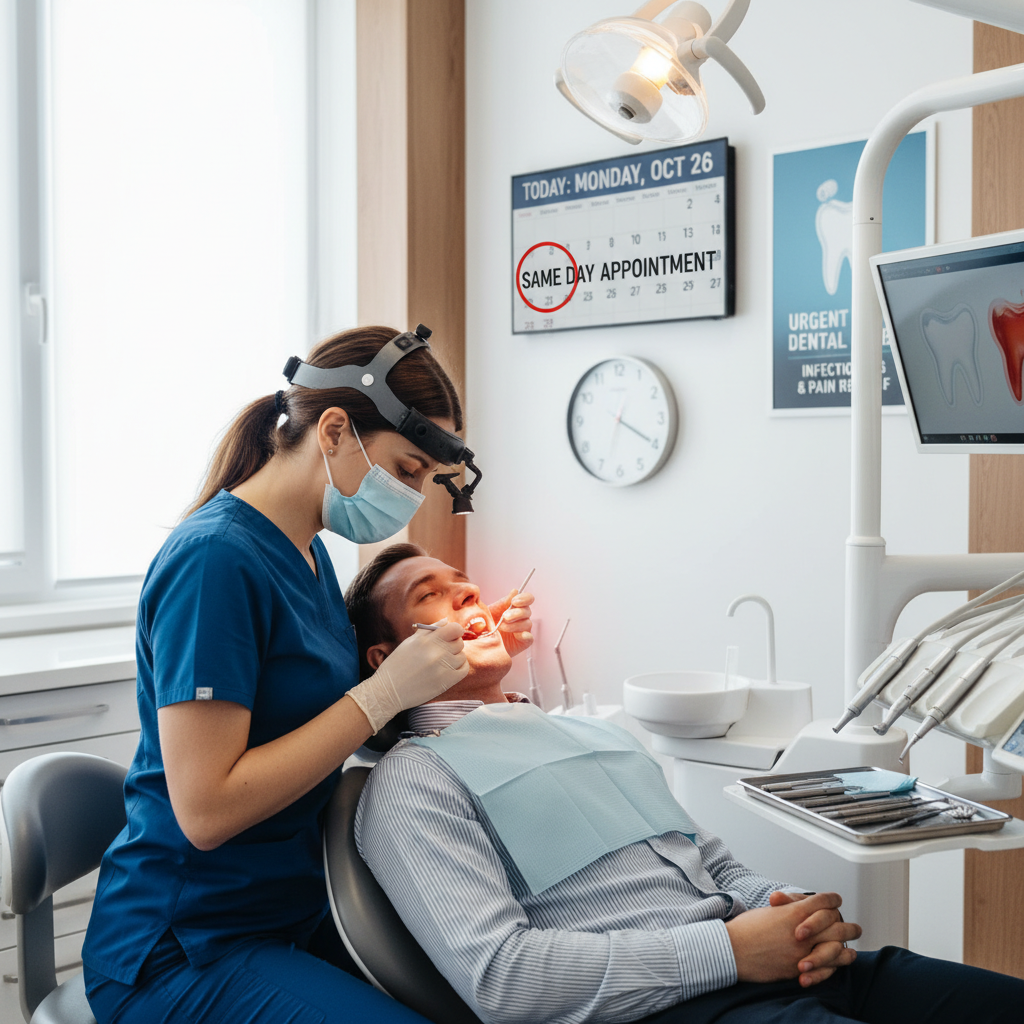
Most dental offices reserve time daily for emergency appointments and can often see you the same day, especially for infections and severe pain [2].
If your symptoms include trouble breathing, swallowing, or rapidly increasing swelling around your neck or eye, you should go directly to the nearest emergency room.
Taking the next step toward relief
If you suspect you have a tooth or gum infection, the most important decision you can make is not to wait. Same day evaluation allows your dentist to:
- Confirm whether you have an infection
- Relieve your pain safely
- Stop the infection from spreading
- Protect your teeth, gums, and overall health
While it is understandable to worry about cost, timing, or inconvenience, the risks of delaying care for a dental infection are much greater. Early treatment is simpler, more comfortable, and usually more successful than waiting until the problem becomes an emergency.
Your best move is to contact a same day dentist for infection as soon as you notice serious tooth pain, swelling, or signs of abscess. With prompt, professional care, you can get out of pain, protect your health, and return to your normal routine with confidence.